
EN
International Day of Families is a moment, marked on 15 May each year, to recognise the central role families play in our societies and to reflect on whether laws, policies, and practices protect the rights of everyone within them.
Families can be places of care, belonging, and support. But for many women and girls, discriminatory family laws mean the home is also where inequality is first experienced and most deeply enforced.
Without equality in the family, equality in society is impossible.
Family law refers to the laws, rules, procedures, customs, and practices that govern relationships within families.
This includes laws relating to marriage, divorce, child custody, guardianship, inheritance, matrimonial property, and the right of a spouse to choose their profession or occupation. It can include civil law, customary law, religious law, and uncodified practices.
When family laws are equal and rights-based, they can protect women and girls’ autonomy, safety, and economic security. When they are discriminatory, they reinforce unequal power within the home and across society.
Discriminatory family laws can affect almost every area of a woman or girl’s life.
They may allow girls to be married before they are 18, give men greater rights in marriage or divorce, deny women equal custody or guardianship of their children, favour sons over daughters in inheritance, or leave women without a fair share of matrimonial property after divorce or widowhood.
These laws do not only cause harm within the home. They can limit women’s access to education, employment, property, financial independence, healthcare, and public life. They can also make it harder for women to leave abusive relationships or protect their children.
Our research on family laws in Africa found that discrimination continues across areas including legal pluralism, child marriage, polygamy, marital rape and domestic violence, divorce, child custody, inheritance, and matrimonial property.
Family law shapes who has power, freedom, and protection in some of the most personal parts of life.
When women are denied equality in the family, their ability to thrive in public life is also undermined. Unequal laws restrict women’s economic participation, political empowerment, health, safety, and ability to make decisions about their own futures.
Legal equality in the family is also an economic imperative. When women can work, own property, inherit, move freely, access education, and make decisions on an equal basis, families, communities, and economies benefit.
International human rights standards are clear: governments have an obligation to eliminate discrimination in marriage and family relations. This includes ensuring equality in entering marriage, during marriage, at divorce, in relation to children, and in property and inheritance rights.
Equality Now is working to end sex discrimination in family law, because legal equality must begin at home.
We advocate for the reform of discriminatory family codes, personal status laws, customary laws, and religious laws and practices that deny women and girls equal rights. We provide legal expertise, support evidence-based advocacy, engage international and regional human rights bodies, and work with partners and coalitions to build momentum for change.
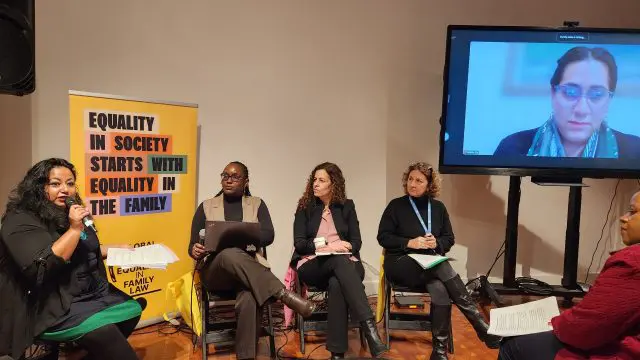
Because family laws can touch on issues such as religion and cultural identity, it often faces pushback and resistance to reform. In 2020, Equality Now helped launch the Global Campaign for Equality in Family Law, and now sits on its steering committee with including SOAWR, FEMNET, Musawah, CLADEM, Women’s Learning Partnership, Act Church of Sweden, Muslims for Progressive Values, and UN Women, with representation from multiple regions and faith-based groups. The campaign calls on governments to protect and promote the rights of all women and girls in laws, policies, and practices relating to families in all their diversity. Because family laws can touch on issues such as religion and cultural identity, it often faces pushback and resistance to reform.
Equality Now also works through regional coalitions advancing family law reform. In Africa, the Africa Family Law Network (AFLN) brings together advocates, legal practitioners, civil society organisations, faith leaders, and activists working to ensure family laws uphold equality for women and girls. In the Middle East and North Africa, the Hurra Coalition unites feminist legal experts, survivor-led groups, and human rights defenders working to end discrimination in family law across the region.
Through these movements, we are working to ensure that culture, religion, or tradition are never used to justify discrimination. Families should be places where every person can live with dignity, autonomy, safety, and equality.